
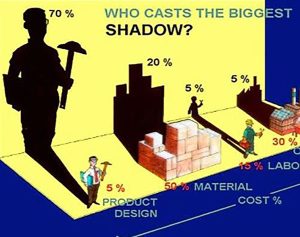
Are you designing a plastic part? How much impact does product design have on the total cost of your project? Let’s break it down using this classic image from one of America’s leading automakers.
Project costs fall into four areas:
- Product Design = 5%
- Materials = 50%
- Labor = 15%
- Overhead = 30%
Does this mean that Product Design is insignificant at just 5%? After all, Materials and Overhead combined account for 80% of project costs. If you include Labor, then a whopping 95% of project costs don’t involve Product Design at all. But is that the full picture? No, it’s not.
But look at the influence. Product Design is the leading cost driver. At 70%, it has over three times the influence of Materials (20%), the next largest category, on the total cost of your project. As for Labor and Overhead, they account for just 5% each. What does this mean in practice?
While product design itself is a small portion of the project cost, your design decisions have an outsized influence on the overall costs and success. That’s why it’s important to make the right choices, and to pick a manufacturing partner who can help you to control costs.
Let’s consider how to calculate project costs and how to perform a cost analysis.
Calculating Project Costs
As a designer, you can use this simple formula to calculate Project costs.
Project Cost = Material Cost + Assembly Labor Cost + Profit
Let’s take a closer look.
- Material Cost includes parts, scrap, and the amortized tooling that you use for parts production. The tooling for thermoforming costs significantly less than an injection mold, but it’s still a cost you need to capture. With raw materials, prices are affected by supply and demand, global distribution, and institutional investors.
- Assembly Labor includes all the labor costs you incur to get a part out the door and to the customer. It encompasses manufacturing, assembly, testing, and packaging. Remember to include payments made directly to workers as well as the cost of benefits like healthcare, vacations, and sick time. In the U.S., you can also include employment taxes.
- Profit is what’s left over after you pay all the bills. This includes salaries, which exceed $100,000 per engineer when you include benefits. There’s also rental space for offices and lab areas to consider, along with the cost of manufacturing areas, tools, and fixtures. Don’t forget about the cost of office equipment, heating, and lighting either. There’s also a cost to maintaining an inventory of raw and finished materials along with phones, Internet, marketing, and product liability insurance.
Performing a Cost Analysis
Cost calculations are valuable, but what if you don’t have all the information you need? There are different approaches to cost analysis. Let’s call them Levels 1, 2, and 3.
- Level 1 is parametric. It’s a first impression from an experienced engineer about what a part, assembly, or system will cost. Remember to include a markup.
- Level 2 is by analogy. It’s an estimate based on your experience with related products. Alternatively, it can be based upon vendor quotes, budget estimates, or expert opinion. It helps to consider a project’s subassemblies. What are they made of, and is there a trendline?
- Level 3 is analytical. It involves a detailed costing for every part and requires material cost estimates plus time and motion studies. By comparing your project to industry standards and vendor quotes, a high degree of accuracy is achievable.
Recommendations
When you buy materials, remember to get quotes for more than you might purchase. That’s because as total quantity increases, unit price decreases. Asking for quotes in higher amounts might change your thinking about economic order quantity (EOQ), the ideal order size without overspending.
First, however, you’ll need a bill of materials (BOM). You’ll also need to project the maximum number of units you plan to sell in the product’s first year.
- The BOM lists all the parts and raw materials that it takes to make your product. For each individual part, the BOM needs to include the part name, description, quantity used, weight and dimensions, and material
of construction. - The maximum volume is the greatest number of units you plan to make in your product’s first year. This is critical because it’s the volume at which to cost your product. If you think your sales will increase in future years, you can adjust your calculations then.Fortunately, there’s software you can use to calculate costs. For example, DFMA® stands for Design for Manufacture and Assembly and is a proprietary software solution that integrates manufacturing and assembly considerations right from the start of the design process.
Pick a Partner—Not a Parts Provider
When you’re designing a plastic part, no one cares about the cost of your prototype—unless, of course, you exceed your budget. With production parts, however, it’s important to follow this formula.
Project Cost = Material Cost + Assembly Labor Cost + Profit
You’ll also need a BOM and a production volume for your product’s first year. Yet there’s something else to consider as well. The right manufacturing partner can make cost-savings recommendations about product design and material selection. And a well-run partner has lower labor costs due to greater efficiencies.
When you partner with Profile, you can get the design for manufacturing (DFM) assistance you need to make the best possible decisions for your project. We also offer value-added services like high-level mechanical assemblies, the kitting of sourced components, and support for customer-driven Kanban initiatives.
This white paper is based on presentation that Ford Motor Company presented as part of Ford-MIT Alliance, a partnership with the Massachusetts Institute of Technology that began in 2004
Image Source: Ford Motor Company
Let’s talk about how to make your part right.Our guiding principle for doing business is simple but powerful: We’ll make it right. Schedule a Call with one of our experts, or use our Contact Form to start a conversation. |