
How large durable parts help equipment take a hit
Equipment outer cover panels, in any industry, function as protective shields as well as aesthetic branding statements. Enclosures need to withstand vibration, weather, heat, service access, and cleaning appropriate to the application.
Along with demanding use, enclosures must also withstand occasional abuse. Functional cover panels must distribute impact energy without cracking, denting, or permanent deformation.
Pressure forming helps OEMs meet the aesthetic, mechanical, and environmental performance requirements of their application, including impact resistance, at a lower total cost. Heavy-gauge thermoforming processes produce large durable parts with molded geometry and integrated features in low-to-medium volumes.
Choosing from a variety of manufacturing process options
Even complex pressure forming tools cost significantly less than injection molding
No one process is universally best. Along with how a part performs in the service environment, each process needs to be considered for load, geometry, size, assembly strategy and annual volume.
Pressure forming occupies an attractive middle ground between the other production methods. The tooling needs a substantially smaller financial commitment and allows consolidating multiple fabricated pieces. The process produces lightweight, long life parts with high durability.
But how well do pressure formed parts handle impacts? The design is key, but you need to start with choosing the right material.
Choosing thermoplastics with higher impact resistance
While the forming process creates the geometry, the plastic sheet supplies much of the underlying performance. Along with impact resistance, materials should be evaluated for tensile strength, abrasion resistance, and brittleness.
Several thermoformable plastics can be considered for superior impact resistance. Different resins offer different specific benefits. For example, polycarbonate provides transparency like glass while being over 200x stronger.
Choose the right plastic for the application
- ABS
- HIPS
- HMWPE
- Polycarbonate
- PC/ABS blends
- PVC/Acrylic blends
Chemical characteristics determine how each material performs. Added colorants, flame retardants and stabilizers, even recycled content can change behavior, including impact resistance.
Wall thickness influences impact resistance. Choosing the right starting gauge is critical for a successful design.
Environmental conditions also affect material performance. Review the chemical exposure or operating temperatures that parts are likely to experience in the field. Resins like ABS offer good overall impact strength but can become brittle in cold weather.
See Profile’s Material Selector for more detail about each thermoplastic.
Ways to test impact resistance
the Izod test and Falling weight test are primary impact resistance tests
Izod tests measure how much energy a notched bar can absorb before breaking. This is useful for testing lot-to-lot quality consistency.
Falling Weight tests drop a weight onto the part. These became standard because they offer more real-world insight. However, results can vary based on the thickness and shape of the sample, so it’s important to evaluate real parts.
The ball pressure test indicates material stability
Not all materials or even all tests are optimal for every application. Don’t just pick the material with the highest test value. Instead, assess the actual part in real-world conditions to make sure it performs as needed, especially if the material has been customized.
How heavy-gauge thermoforming improves performance
Improved performance of pressure-formed enclosures reflects the interaction of the plastic and the geometry. A tough polymer can flex locally and absorb energy rather than denting like metal or fracturing like a brittle material. Adding broad radii, transitions, and ribs to the formed shape can increase stiffness without adding mass.
- Fewer seams. Large single-piece panels can replace multi-part fabricated assemblies. Fewer joints mean fewer fasteners, less assembly labor, and fewer potential water or dust entry points.
- Molded-in durability. Color, texture, gloss, and weatherable cap layers can be integrated into the sheet, which eliminates painting for suitable applications and avoiding visible scratches or chips.
- Repeatable protection. Controlled forming and CNC trimming can produce consistent edges, holes, and interfaces for seals and hardware.
- Design freedom at large scale. Pressure forming can produce features on parts that would require extensive metal fabrication.
Thermoforming simplifies design improvements
Process is not a substitute for good engineering. Design for manufacturing (DFM) is vital for the success of any OEM component. Thermoforming not only uses less expensive tooling than other processes, they can be revised for less cost as well.
A housing that resists cracking, corrosion, dents, and finish damage can reduce field repairs, cosmetic claims, and replacements. However, quality and impact resistance gains must be validated for the finished part rather than assumed from flat sheet data alone.
Since thermoforming is essentially a stretching process, achieving a uniform thickness in the final part can be difficult. If the sheet’s starting thickness results in thin walls, a heavier gauge can often be easily substituted without requiring new molds. A thicker sheet boosts rigidity and impact resistance but does add some cost.
Conclusion
Impact resistance is only one aspect of part performance and product costs. Heavy-gauge pressure forming unites high-impact thermoplastics with geometry that handles loads, attractive surfaces that survive the environment. All while using economical tooling.
Strong development programs bring product design, engineering, sourcing, the thermoformer, and even the sheet supplier together early. The resulting parts or enclosures look better even after years of use while reliably protecting important components.
Be sure to work with a thermoformer who has the material expertise to identify the best thermoplastic for your project. You can even ask them to sample some high-impact resins on existing tools. That can allow you to begin testing early in development.
You can count on Profile Plastics for the knowledge and experience to address your most demanding needs at a lower total cost.
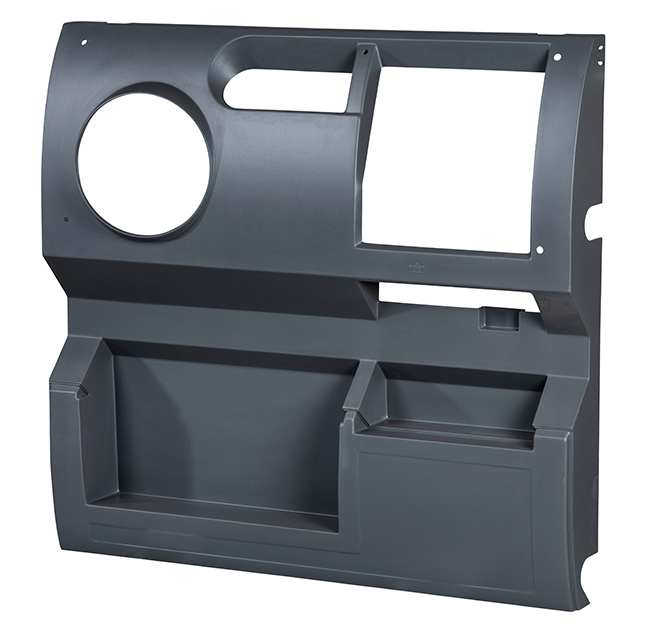
forklift cockpit front panel
Rugged thermoformed parts are often used in industrial equipment

Rugged thermoformed parts are often used in industrial equipment

twin-sheet formed part showing different color materials
With twin-sheet forming, you can combine materials with different colors or thicknesses

Twin sheet table example
Twin-sheet forming creates rugged multi-colored plastic parts
More Tech Articles
-
Designing plastic equipment enclosures for 2027
-
Achieve superior impact resistance with thermoformed parts
-

How thermoforming has recreation and fitness manufacturers covered
-

How materials influence part design in thermoforming
-

The Elements of Part Design
-

Cost Considerations In Designing for Thermoforming
-

Consider process attributes for successful thermoforming
-

How to overcome the challenge of deep draw parts
-

10 Ways to improve plastic component performance and prevent failure
-

Video: The ultimate guide to optimizing part design